Naruto Card Game rules: how to play
Each player builds a deck around a Leader and wins by bringing the opponent's Leader Life down to zero. What makes the game stand out: your ninjutsu techniques are set face-down, and your opponent has to guess what's coming.
Bandai hasn't published the full rulebook yet. This page gathers everything that has been officially shown, and flags what is still unconfirmed.
What you need to play
| Component | Count | What it does |
|---|---|---|
| Leader card | 1 | Your main card: its Life is what your opponent attacks |
| Main deck | 50 cards | Your Characters, drawn over the course of the game |
| Chakra cards | 5 | The energy that pays for your techniques |
| Summon card | 1 | Lets you put your Characters into play |
Counting the Leader, Bandai describes it as a 51-card deck. Our deckbuilder (coming soon) will check your deck automatically.
Only one deck-building rule is known so far: your Characters must match your Leader's color. Picking a Leader means picking a color and a play style.
How to win
Bring the opposing Leader's Life to 0. Both Leaders shown by Bandai, Naruto and Sasuke, have 15 Life.
Reading a Character card
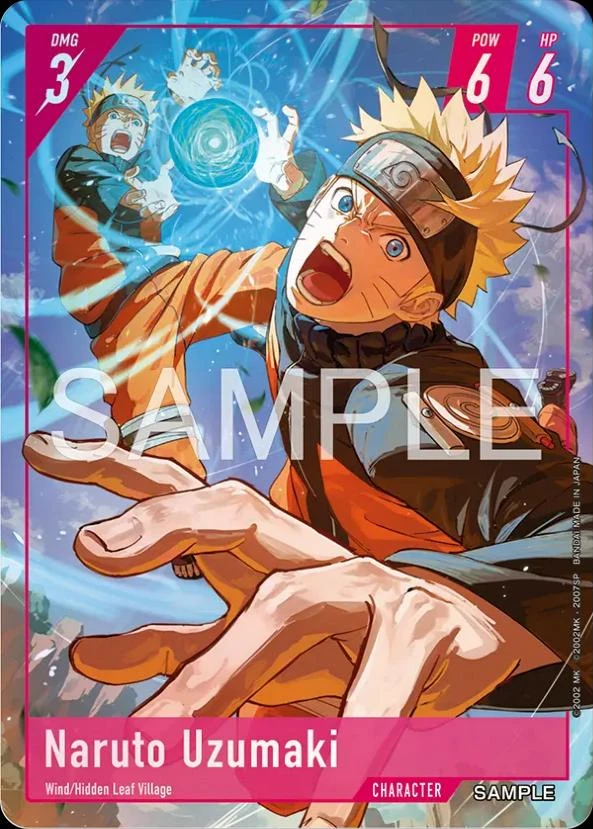 1
2
3
4
5
- Damage (DMG): what the card deals when it hits.
- Power (POW): its strength in battle. Many effects change it ("+3 power during this turn").
- Hit Points (HP): how much it can take. On a Leader, this box becomes LIFE.
- Name and traits: village, clan, team or chakra nature (Wind, Lightning…). Some effects target a specific name or trait.
- Card type: Leader, Character, EX Character, Chakra or Summon.
The frame color is the card's color (red, blue, green…). Cards with an effect have a text box above the name.
The 5 card types
- Leader: it never leaves play and has its own effects, often tied to Chakra.
- Character: your fighters, put into play with the Summon card. Many also have a Support box: a technique you activate by paying Chakra (see below).
- EX Character: very powerful cards that cannot be summoned normally. You have to meet a requirement. Example: Gamabunta asks you to place one of your Characters with 10 or more power in your trash.
- Chakra: your 5 energy cards. To pay for a technique, you flip a Chakra card face-down.
- Summon: you rest it (turn it sideways) to summon a Character.
The heart of the game: hidden techniques
This is what sets the Naruto Card Game apart from other card games:
- You set cards face-down in your support area (up to 5 cards, according to an official visual).
- At the right moment, you spend Chakra to reveal a card and use its technique.
- Your opponent doesn't know what's hidden: bluffing and reading your opponent matter as much as your cards.
Example: Shikamaru's Support box, "Shadow Possession Jutsu", costs 1 Chakra. During your opponent's attack, it summons Shikamaru and interrupts that attack. A perfect counter, if your opponent didn't see it coming.
Getting your Chakra back
Spent Chakra doesn't come back on its own. Both Leaders shown so far have a Recovery effect: if it is the second turn or later, you rest your Leader and flip all of your Chakra face-up. Deciding when to spend and when to recover will be a big part of the strategy.
Turn structure
An official visual shows the phases of a turn, in this order:
- Refresh Phase: your rested cards presumably stand back up.
- Draw Phase.
- Main Phase: summons, effects, attacks.
- End Phase.
The details of each phase haven't been published yet.
Card keywords
| On the card | What it means |
|---|---|
| Activate: Main | An effect you trigger during your Main Phase |
| Once Per Turn | Can only be used once per turn |
| On Summon | Triggers when the card comes into play |
| Summon Requirements | What you must do to summon an EX Character |
| During Your Opponent's Attack | A technique played in response |
| Recovery | A Leader effect that gets your Chakra back |
| Rush | The Character can attack on the turn it is summoned |
| Support | A technique you activate by paying Chakra |
What we don't know yet
- Exactly how battles resolve (the precise roles of Damage, Power and Hit Points).
- The maximum number of copies of a card in a deck.
- Starting hand size and who goes first.
- Tournament rules.
We'll update this page with every announcement, starting with Jump Festa on December 19 and 20. The cards mentioned here are in the card database.